I am a beautiful reflection
Of the Sun’s affection
Loved by the Sun
Kissed by the Moon
The apple of my Daddy’s eye
A twinkle in the evening sky
Sometimes the first; sometimes the last
I am the future; I am the past
Although I sometimes don’t appear
Be assured, I’m always here
As of 2005 54% (3.6 billion people) of the world’s population considered themselves adherents of an “Abrahamic religion.” Christianity being the largest at 33%, Islam second at 21% and Judaism at 0.02%. All “Abrahamic religions” claim a direct lineage to the Biblical Patriarch, Abraham.
Jesus said, If you are the children of Abraham, you would do the works of Abraham. So let’s see how well connected these “religions” really are to Abraham!
“Let us therefore be in awe/reverence, lest a promise being left us of entering into His Rest, any of you should come short of it… There remains, therefore, a keeping of a Sabbath to the people of God.” Hebrews 4
Many argue that the day of rest called for by God is Saturday (the seventh day of the week) or Sunday (the first day of the week). God called for His people to keep the weekly Sabbath, the seventh day, as a token to remember the Sabbath Day to keep it holy unto Him. But the true Sabbath is much bigger than that. It is written, “Don’t be ignorant of the one thing: One day to the LORD is as a thousand years” (2 Peter 3:8), and “in six days, that is six thousand years all things will be accomplished” (Barnabus 13:4-5). Genesis 2 tells us that God finished His work on the sixth day and on the seventh day He rested and sanctified that day to be kept to Him.
The Party’s Over, by The Christian Choristers
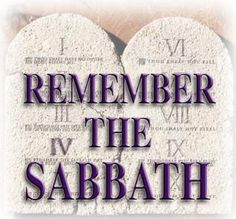
Remember the Sabbath Day to keep it holy unto the God of Abraham, Isaac and Jacob
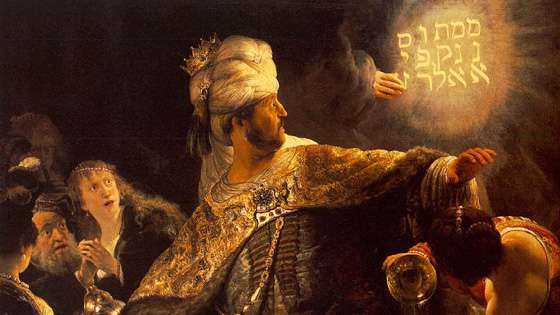
King Belshazzar was greatly troubled and his lords were astonished!
“Mene, Mene, Tikel Upharsin.” These were the Hebrew words written on the wall in the Biblical Book of Daniel. The only one who could interpret them for Belshazzar, King of Babylon, was Daniel, a Jewish man who had been taken into captivity from Judea by Nebuchadnezzar. Before interpreting the words, Daniel reprimanded Belshazzar for not humbling himself before the God of Heaven. He had in fact exalted himself against God, stolen the vessels from the Temple in Judea and was using them in his own temple to drink wine and party with his friends. Belshazzar worshiped gods/idols of gold and silver which “neither see, nor hear, nor know” anything. Therefore, God sent a hand to write on the wall before the king: “Mene. Mene, tekel, upharsin.” When the king’s “wise” men, magicians, and priests couldn’t tell him what it meant, he finally called Daniel.
What does Easter have to do with Passover? In a word: nothing! Both “holy days” are celebrated in the Spring and both are described as “abomination” in God’s Word. These designations are all they have in common. Easter originated in ancient Babylon as the worship of the “god” Tammuz and his mother, Ishtar/Ashtoreth and while they say Passover originates in the Torah, when looked at closely there is little resemblance to what they do and what is contained in the Book of Exodus and all the Law. Hebrews 10:1, says “the Law is a shadow of good things to come and not the very image of the thing.”
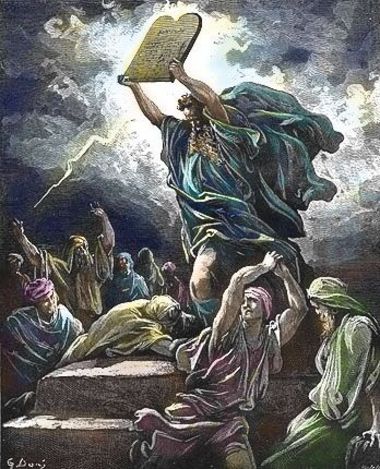
The Laws of the Covenant
“You shall not make to yourselves any graven image… You shall not bow down to them nor serve them, for I the LORD your God am a jealous God…” Exo 20:4-5
According to Wikipedia, “Saint Patrick’s Day, or the Feast of Saint Patrick, is a cultural and religious celebration held on 17 March, the traditional death date of Saint Patrick, the foremost patron saint of Ireland.” This doesn’t really give much information! The truth is the whole tradition of Patrick is nothing but a deception designed to make the Irish people forget their heritage and follow Roman Catholicism. Patrick’s birth name was Patricius Magonus Sucatus. When he was about 14-16 he was captured by Irish raiders and taken to Ireland where he was enslaved by them to be a herdsman. After some time, he escaped on a ship headed for Gaul where he became a disciple of Germanus of Auxerre, proclaimed another Catholic “saint,” a man criticized for leading people in pagan ways, who went to Britain preaching and setting up seminaries.